
Topics of Interest
Topics of Interest
Commercial Motor Vehicle Safety
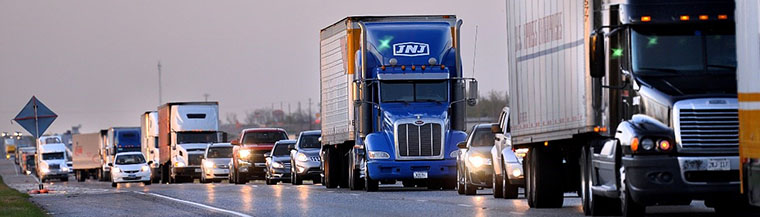
Buses and trucks with gross vehicle weight ratings of more than 10,000 pounds are involved in significant numbers of fatal work zone crashes each year. Collectively, these vehicle types are referred to as commercial motor vehicles (CMVs).
What does the data say?1
Figure 1 illustrates that the overall trend has been a decrease in CMV-involved fatal work zone crashes since 2021. However, the percentage of all fatal work zone crashes that involve a CMV has remained relatively steady over the same period. For comparison purposes, CMV involvement in non-work zone fatal crashes has remained relatively constant at about 12-13 percent during the same time period.
![Line graph showing CMV-involved fatal work zone crashes have trended upwards, rising from 210 in 2020 to 236 in 2024. The percentage of all fatal work zone crashes that involve a CMV has remained relatively steady, between 27 and 34 percent during the same period. (Source: NHTSA FARS. The 2020-2023 data were taken from the FARS final data files, while the 2024 data were from the FARS 2024 Annual Report File [ARF]. All data were downloaded in April 2026.)](https://workzonesafety.org/wp-content/uploads/2026/05/2024_CMV-fatal_crashes_percent.jpg "CMV-Involved Fatal Work Zone Crashes And Percent Involvement in All Fatal Work Zone Crashes, 2020-2024")
Figure 1. CMV-involved fatal work zone crashes and percent involvement in all fatal work zone crashes, 2020-2024 (Source: National Highway Traffic Safety Administration [NHTSA] Fatality Analysis Reporting System [FARS]. The 2020-2023 data were taken from the FARS final data files, while the 2024 data were from the FARS 2024 Annual Report File [ARF]. All data were downloaded in April 2026.).
Figure 2 further illustrates that CMVs are involved in more than 30 percent of fatal work zone crashes on urban interstates and almost 60 percent of fatal work zone crashes occurring on rural interstates. CMV involvement is also higher than overall trends in fatal work zone crashes on other roadway types as well.
![CMVs are highly overrepresented in fatal work zone crashes as compared to fatal non-work zone crashes. In fact, CMVs are involved in almost 60 percent of fatal work zone crashes that occur on rural interstates. (Source: NHTSA FARS. The 2022-2023 data were taken from the FARS final data files, while the 2024 data were from the FARS 2024 Annual Report File [ARF]. All data were downloaded in April 2026.)](https://workzonesafety.org/wp-content/uploads/2026/05/2022-2024_commercial_vehicle.jpg "Commercial Motor Vehicle Involvement in Fatal Work Zone and Non-Work Zone Crashes, 2022-2024 Average")
Figure 2. CMV involvement in fatal work zone crashes by facility type, 2022-2024 average (Source: NHTSA FARS. The 2022-2023 data were taken from the FARS final data files, while the 2024 data were from the FARS 2024 ARF. All data were downloaded in April 2026.)
What is the cause?
It is not clear from the available data whether the overrepresentation of CMV involvement in fatal work zone crashes is due to:
- more work zones on roadways with more CMVs,
- more CMVs traveling to and from the work zone to deliver and take away materials and equipment, or
- because work zones are more challenging for CMV drivers to negotiate, or
- because driver distraction/inattention results in more frequent rear-end collisions by CMVs and into the rear of CMVs by non-CMVs.
All four possibilities may be partially responsible. Consequently, it will take efforts from federal agencies, state and local transportation and enforcement agencies, contractors, CMV fleet operators, CMV drivers, and non-CMV drivers to help reverse these trends.
Join the mailing list for CMVs in work zones
The Clearinghouse continues to seek out information on what agencies, contractors, fleet managers, and others are doing to reduce the risks of CMV-involved work zone crashes. Please share through the Commercial Motor Vehicle Safety in Work Zones Mailing List if you have examples of plans, programs, or other efforts undertaken to reduce the risks of these crashes in work zones. Your contributions can then be added to the existing list of available resources.
Where can I find more information?
The Work Zone Fatal Crashes and Fatalities dashboard contains state-by-state data on large truck and bus-involved fatal work zone crashes and fatalities.
1 In the NHTSA FARS dataset, CMVs consist of large trucks and buses with gross vehicle weight ratings of more than 10,000 pounds that have an applicable Body Class in NHTSA’s Product Information Catalog and Vehicle Listing (vPIC) dataset. The vPIC-based analysis data are available beginning with 2020 Fatality Analysis Reporting System (FARS) data files. Vehicle-related analysis for 2020 and later years are based on vPIC vehicle classification. As a result, the 2020 and later-year vehicle type classifications are not comparable to 2019 and earlier-year vehicle type classifications. This change affects any analysis with a vehicle component to it. More information on vPIC can be found at https://vpic.nhtsa.dot.gov/.